How Progressing Ballet Technique (PBT) Helps Dancers Improve Faster

Hayden Creech

Share this article

Progressing Ballet Technique (PBT) is a conditioning system for dancers that builds muscle memory and mind-body awareness.

If your dancer wants to get better faster (because who doesn’t?), then PBT is their road map.


At Southeast School of Dance, we teach PBT weekly, giving dancers regular and methodical dance conditioning. We believe the strength and deep muscle control PBT builds is essential for supporting the turnout, posture, and alignment that many styles of dance demand. 


And we believe this because we’ve seen it. Time after time, the dancers who invest in outside-of-technique-class conditioning are the ones who improve faster. 

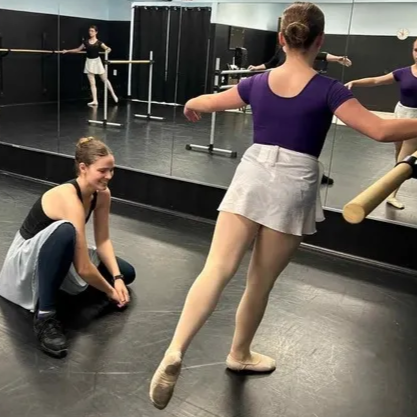
Dance studio with a ballet dancer practicing in front of mirrors while their teacher provides instruction

PBT Frequently Asked Questions

What if ballet isn’t my child's favorite style of dance?
Saturday PBT is open to students of various levels and styles of dance. While the exercises are rooted in balletic coordination, PBT vocabulary is vast. We practice a bank of exercises that are accessible, adaptable, and applicable for all forms of dance.


Will my child need to bring their own equipment?
No, we provide mats and various types of balls and bands. Everything you need for effective practice is ready and waiting at the studio.


What should my child wear to PBT class?
A leotard and tights are preferred but any form-fitting clothing works. Hair should be pulled away from the face but buns are discouraged (they can be uncomfortable when lying on the mat). 


What makes PBT different from barre, sculpt, and other dance fitness classes?
Surprisingly, most dance fitness classes are not designed for dancers. Instead of focusing on low-impact cardio and the “burn” of sculpt fitness, PBT targets deep stabilizing of muscles. Dancers walk away from PBT class with a deeper body awareness instead of a heavy soreness. Both have their time and place, but PBT translates directly into technique classes which makes all the difference, especially when practiced consistently, week after week and season after season.
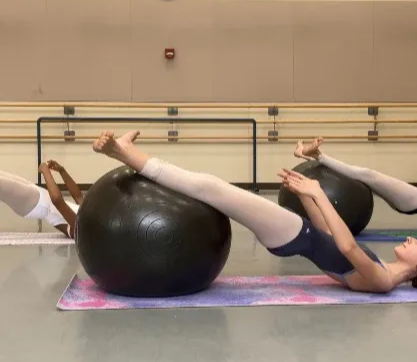
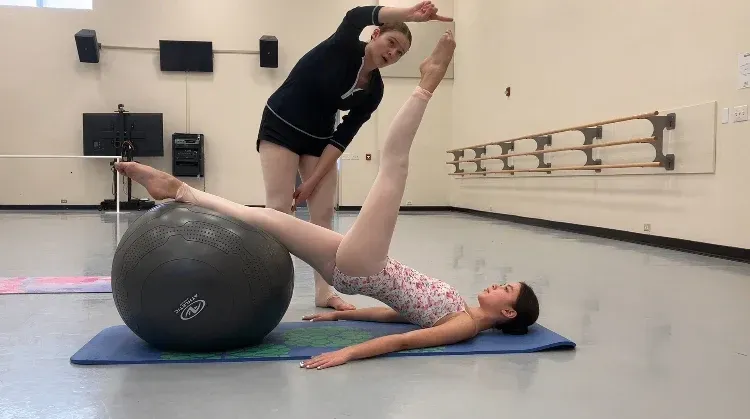
Students in PBT class using a ball and mat to strengthen muscles
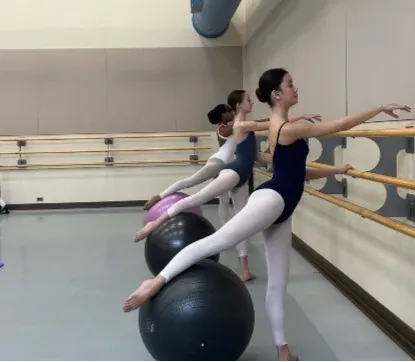
3 ballet students practicing PBT at the barre with exercise balls in the dance studio

What Drives This Improvement

PBT is equipment-based, using yoga balls, Pilates balls, and 10-foot resistance bands. With these props dancers quickly develop proprioception (the awareness of their bodies within space). 


Balls wobble, highlighting hidden muscle weakness. Dancers learn where they may be “gripping” to force movement instead of letting it come efficiently. Bands wrap, stimulating muscle activation through friction and pull. Dancers learn what they may need to engage to replicate that sensation on their own.


Rather than simply telling a dancer what to correct, equipment provides specific and immediate feedback on form. This builds mind-body awareness and a deeper understanding of movement. Dancers learn for themselves what needs correction based on the feedback from equipment–both kinesthetic and tactile.

PBT is ultimately so effective because dancers aren’t just told what to do, they learn why they’re doing it and how it applies to their dance technique. “Where do you feel it?” we ask. “How does this translate to ballet class?” “What needs to change?” PBT molds self-correcting dancers. They learn to improve at their own pace with their own initiative. Not only does this advance your dancer’s technique, it advances their critical thinking skills. And that goes far beyond the studio.

Hayden Creech leading a student in PBT exercise on a mat with a stability ball in the dance studio

The Bigger Picture

By integrating PBT into the curriculum, Southeast School of Dance provides an opportunity for dancers to experiment with what correct technique feels like. Beyond simple strength and stretch exercises, this technique creates efficiency, teaching dancers what it means to dance freely. 


Through PBT we reduce injury risk and create an ease of movement, molding dancers whose bodies don’t get in the way of their artistry and expression. Regardless of whether a dancer takes ballet, PBT creates a deep body control, the foundation from which true dance, not just the replication of steps, shines through.

Ready to Get Started?

This season is the perfect time to see these mind and body benefits for yourself. Register today for weekly PBT and see how your dancer transforms.


See you in class,

Miss Hayden


Read more about my PBT background.

Elevate your training with private in-studio PBT and live, one-on-one online PBT coaching

Southeast School of Dance graphic of 3 dancers striking 3 unique poses

Recent Posts

Children in workout clothes stretching with arms raised in a dance class
By Nicole Rowland July 23, 2026
Dance builds more than technique. Discover how melody, movement, and magic develop confidence, focus, and character at Southeast School of Dance.
Two ballerinas in lavender tutus sit on a purple studio floor, smiling at each other beside a doll.
By Nicole Rowland July 2, 2026
Wondering when to start dance classes? Southeast School of Dance explains why age 3 is the sweet spot and what your child can expect in their first class.